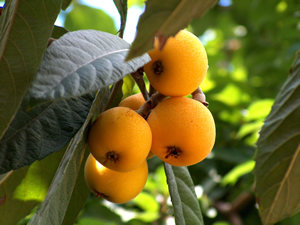
Loquat (Eriobotrya Japonica). The name means literally ‘reed orange’. It is more commonly known as pipa for its similarity to the shape of the Chinese musical instrument.
Loquat is in the Rose or Rosaceae family of plants.
Loquats are indigenous to South Eastern China and have been used by humans for over a thousand years. Eriobotrya is a large evergreen shrub or small tree in central Texas with a rounded crown. The tree can grow up to fifteen feet tall and is often planted as a landscaping plant. The leaves are alternate simple dark green tough and leathery in texture. The flowers produce a cluster of oval or rounded pear shaped orange or yellow fruits about three inches long and an inch or two in diameter. The fruits are usually sweetest when soft and yellow usually by late April into May in Central Texas. The skin can be peeled off, and the fruit eaten right off the bush, spitting out the seeds.
The fruits are commonly used to make jam, jelly and chutney and are often served poached in a light syrup.
Herbalists in Cyprus, Japan, China and India have used loquat leave tea with some success with various types of cancer, diabetes mellitus, chronic bronchitis, coughs and skin diseases. There is a small book in Japanese called ‘Natural Remedy’ by Yuriko Tojo that describes various ways to use the Loquat internally and externally for moxa. The plant is thought to be anti-inflammatory and an expectorant. Seeds are known to contain amygdalin an anti cancer substance that is being investigated.
Plants in the rose families seeds are usually avoided due to potential toxicity so experiment with those with caution or under a health practitioner’s guidance. Specifically the leaves of loquat are used for the treatment of cough due to lung heat or dryness with phlegm that’s difficult to expectorate; a dry cough with little or no phlegm.
I first started using loquats – both the leaves and the fruit – in my cough syrups because my friend could not afford the prescription to get the cough syrup from a Chinese pharmacy. I heard her plight and reflected on the abundance of the trees all over Austin. We came together and made a raw fruit mash and warmed it with a little water, and added the leaf and other herbs and fused it for many hours and preserved it later with raw honey after straining out everything. Presto, a delicious, local loquat cough syrup that works great.
Since doing this I have tasted a few of the Chinese preparations direct from China, and I have found they pale in comparison not just on effectiveness but on taste and purity. Loquat fruit is abundant and people are very happy to offer you their fruit. Be on the look out around Austin and try this fruit in your next jelly or chutney recipe!
Thanks for joining me on this walk through the wild side and remember herbal medicine is a powerful healing modality. Please consult a trained clinical herbalist and or wildcrafter to help you make the best and safest and most sustainable choices when harvesting herbs and using them medicinally.
The above text is a transcript of the embedded video.